


Page 59 - Tvisobrivi kvleva__GEORGIA - English
P. 59
Study on Adult Learning and Education in Georgia


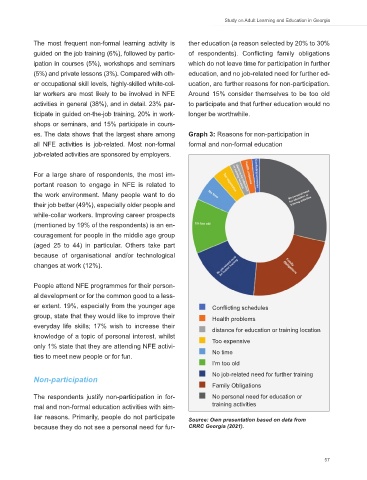
            The  most  frequent  non-formal  learning  activity  is   ther education (a reason selected by 20% to 30%
            guided on the job training (6%), followed by partic-  of  respondents).  Conflicting  family  obligations
            ipation in courses (5%), workshops and seminars     which do not leave time for participation in further
            (5%) and private lessons (3%). Compared with oth-   education, and no job-related need for further ed-

            er occupational skill levels, highly-skilled white-col-  ucation, are further reasons for non-participation.
            lar workers are most likely to be involved in NFE   Around 15% consider themselves to be too old
            activities in general (38%), and in detail. 23% par-  to participate and that further education would no
            ticipate in guided on-the-job training, 20% in work-  longer be worthwhile.
            shops or seminars, and 15% participate in cours-
            es. The data shows that the largest share among     Graph 3: Reasons for non-participation in
            all NFE activities is job-related. Most non-formal   formal and non-formal education

            job-related activities are sponsored by employers.


            For a large share of respondents, the most im-
            portant reason to  engage in NFE  is related to
            the work environment. Many people want to do
            their job better (49%), especially older people and
            while-collar workers. Improving career prospects
            (mentioned by 19% of the respondents) is an en-
            couragement for people in the middle age group

            (aged 25 to  44) in particular.  Others  take part
            because  of  organisational  and/or  technological
            changes at work (12%).


            People attend NFE programmes for their person-
            al development or for the common good to a less-
            er extent. 19%, especially from the younger age             Conflicting schedules

            group, state that they would like to improve their          Health problems
            everyday life skills; 17% wish to  increase their           distance for education or training location
            knowledge of a topic of personal interest, whilst           Too expensive
            only 1% state that they are attending NFE activi-
            ties to meet new people or for fun.                         No time
                                                                        I’m too old
                                                                        No job-related need for further training
            Non-participation
                                                                        Family Obligations
            The respondents justify non-participation  in for-          No personal need for education or

            mal and non-formal education activities with sim-           training activities
            ilar reasons. Primarily, people do not participate   Source: Own presentation based on data from
            because they do not see a personal need for fur-    CRRC Georgia (2021).


                                                                                                              57

